


Have you ever hit the pavement only to have your knees start to complain a few miles into the run? In addition, your running shoes wear down faster than your other footwear. If it sounds familiar, then overpronation may be the reason. The right running shoes for overpronation may be a game, or run, changer.
For overpronators, ensuring you have the right running shoes is going to make your exercise and training much better because the right sneakers keep you healthy. The following guide will break down what overpronation is, how to know if you’re an overpronator, and the seven running shoes to support your efforts.
For a deeper guide on how gait affects shoe selection, check out our post on how to choose running shoes.
How Overpronation Affects Your Feet
Let’s start with the basics. Pronation is the natural inward roll of the foot when it impacts the ground. It’s a part of someone’s gait, but the issue begins when the foot rolls inward too much. At that point, you have overpronation.
It’s important to know whether you run with overpronation because it can stress the knee, ankle, and foot. Further, it can lead to conditions that include shin splints, plantar fasciitis, and IT band syndrome. That’s when the arch of the foot collapses on each foot strike, causing the lower leg to compensate.
Types of Pronation & Running
Generally, runners generally fall into three categories:
- Neutral pronation: The foot rolls inward approximately 15%. Biomechanically, that’s considered ideal.
- Overpronation: The foot rolls inward beyond 15%. In turn, it places stress on the arch and medial structures.
- Supination (underpronation): The foot rolls outward, which is less common. However, it’s still worth addressing.
One of the most common problems among runners is overpronation, so if you have this condition, you’re not alone. It’s estimated that 50-60% of runners have mild overpronation, with an additional 20-30% having more serious overpronation. The wet-foot test for overpronation will tell you whether you have it.
How We Chose the Best Running Shoes for Overpronators
Not all running shoes for overpronation are the same. That said, in our list, we evaluated each sneaker on several key criteria:
- Support technology: Does the running shoe actively address inward rolling (e.g., guiderails, medial posts, dual-density foam, or wide platforms)?
- Cushioning: Joint stress results from overpronation, so shock absorption matters.
- Weight and feel: The best sneakers don’t feel heavy or stiff; instead, they strike a balance.
- Versatility: Can you train in the sneakers daily, or are they more for a few runs?
- Value: Stability carries a price premium, but we looked at whether it’s earned.
The information we reviewed comes from runner reviews, podiatrist publications, and lab test data.
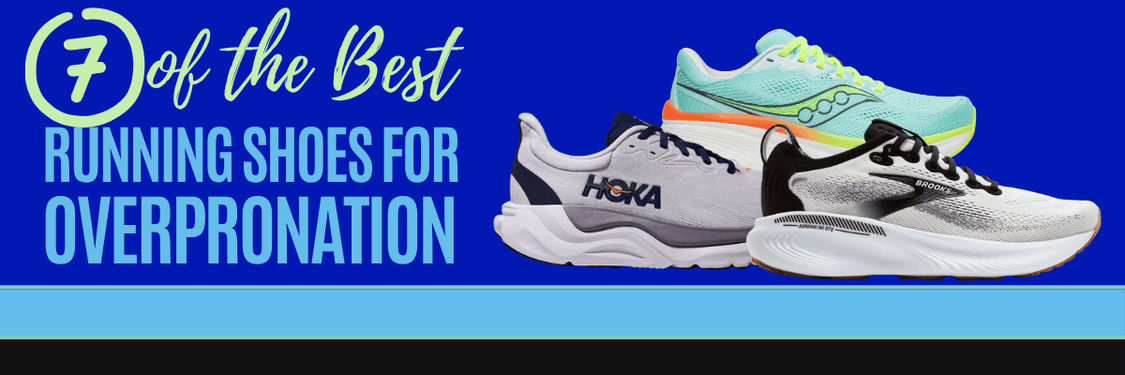
7 of the Best Running Shoes for Overpronation
1. Brooks Adrenaline GTS 25
Best For: Everyday training, mild to moderate overpronation
Price: $155
These sneakers appear repeatedly at the top of the lists we reviewed. The Adrenaline GTS is currently in its 25th edition, so it’s earned its position. Instead of rigid gait correction, the sneaker starts to deviate from its normal path if your foot overpronates. In turn, the correction feels subtle. The midsole delivers solid cushioning, and the platform runs wide, which provides a stable base. Note: the toe box can run slightly narrow.
2. ASICS Gel-Kayano 32
Best For: Moderate to severe overpronation, high-mileage runners, marathon training
Price: $165
If you’re looking more assertive support, then the ASICS Kayano is the running shoe you should consider. It has a wider base, sculpted midsole, and a beveled heel. In addition, the medial foam provides stability throughout the full gait cycle. For overpronation, lab tests show that in wet conditions it scores 68% better than average. It’s a heavier running shoe than the Adrenaline, but the sneakers offer more protection for moderate to severe overpronators.
3. Hoka Arahi 8
Best For: Severe overpronation, runners wanting lightweight stability
Price: $148
The Arahi delivers overpronation control and weighs just 9.1 oz. for men, which is lighter than the average neutral running shoe. The H-frame technology uses firmer foam along the perimeter of the midsole to help prevent inward rolling. In the meantime, the center remains soft and cushioned. The stack height is 39mm, providing solid shock absorption. Caveat: If you’re looking for speed, it’s reported that the toe-off isn’t particularly springy.
4. Saucony Guide 19
Best For: Mild to moderate overpronation, runners wanting a responsive feel
Price: $140
If you’re a runner looking for stability without that sluggish feeling, consider the Guide 19. The running shoe features a wide midsole platform that supports running with overpronation. It also has improved outsole durability and a plush ride. Also, the Guide helps keep the foot from rolling inward, and it’s cushioned for longer runs. Still, it’s not the most corrective sneaker, but it’s one of the best at correcting without compromising the running experience.
5. New Balance Fresh Foam X 860v14
Best For: Mild overpronation, budget-conscious runners, daily training
Price: $140
New Balance’s entry for overpronation is designed to support the midsole geometry through what they call the Stability Plane. It’s a plate embedded in the foam on the inner arch side and custom-made for flexibility on the outer side. The sneakers provide solid cushioning for training, which makes it feel more of a daily sneaker than a support one. Wide toe-box options are available, which is a bonus for overpronators with flat feet that spread.
6. ASICS GT-2000 13
Best For: Budget-conscious overpronators, beginners, everyday wear
Price: $110–$140
If you would like to spend less for a support sneaker, then consider the GT-2000 13. It delivers on genuine support for overpronation at a better price. This sneaker is on the list of best running shoes for overpronation because of that. The sneakers have a wider base and a beveled heel. It’s a relatively lightweight sneaker with a breathable mesh upper that holds up. The truth is, it punches above its price and is the most accessible to all.
7. Brooks Glycerin GTS 23
Best For: Heavier runners, maximum cushioning with stability, long slow distance
Price: $160
Brooks has a second option for overpronation stability who want more cushioning. It provides runners with a thicker, softer midsole stack, which makes it the go-to for heavier runners. It also supports those who are recovering from an injury. Of note, the sneaker isn’t built for speed, but for those days when you want an easy run or need more cushioning for a long run.
What to Do with Running Shoes You No Longer Use
Running shoes have a lifespan, and typically, runners rotate their sneakers every 300-500 miles. And if you have overpronation, it may require changing things up more often to avoid health problems. Still, while you may think it’s time for your sneakers to go into storage, or into a closet, there’s something super special you can do with your running shoes. You can make a local impact and also a global environmental and human impact.
Individuals can participate in the Mail-In Reuse Bag Program and, in the process, support organizations such as RRCA Kids Run the Nation and St. Jude Children’s Research Hospital. If you’re a road race or marathon director, you can join the Austin, Boston, and Marine Corps Marathons as a Sneakers4Good partner and get started in our free sneaker reuse program.
Put Your Best Foot Forward With the Right Pair of Running Shoes
Overpronation doesn’t have to mean injuries or shorter runs. As you can see from our list of running shoes for overpronation, there are strong options to support your runs. Moreover, you and your community can ensure that the value of gently worn sneakers is maximized by getting started by learning more about our sneaker reuse programs. They support local communities, micro-entrepreneur worldwide who sell the shoes, and the planet.
© 2026 Sneakers4Good. All Rights Reserved.